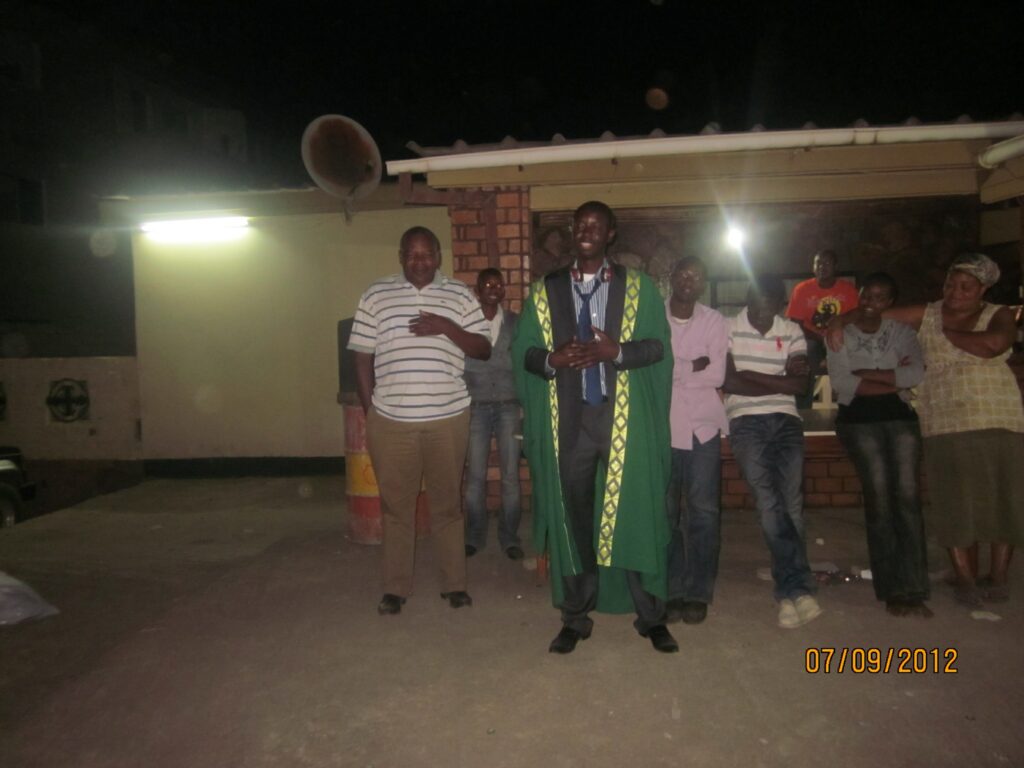
There is a photograph of me receiving my engineering degree.
I am wearing a green graduation gown. I am walking across a stage. Someone important is handing me something I had spent years working towards. Somewhere behind the camera, my family is watching.
If you saw only that photograph, you would probably know what to think.
He made it.
That is what graduation photographs are designed to say.
The gown says you survived the years before it. The degree says you completed something. The smiles around you suggest that people are proud. Everybody looks as though they understand exactly what the moment means.
But photographs are very good at showing you what happened.
They are not always very good at telling you what was happening.
Fourteen years ago today, on Thursday, 6th September 2012, I graduated from the University of Zambia with a Bachelor of Engineering degree.
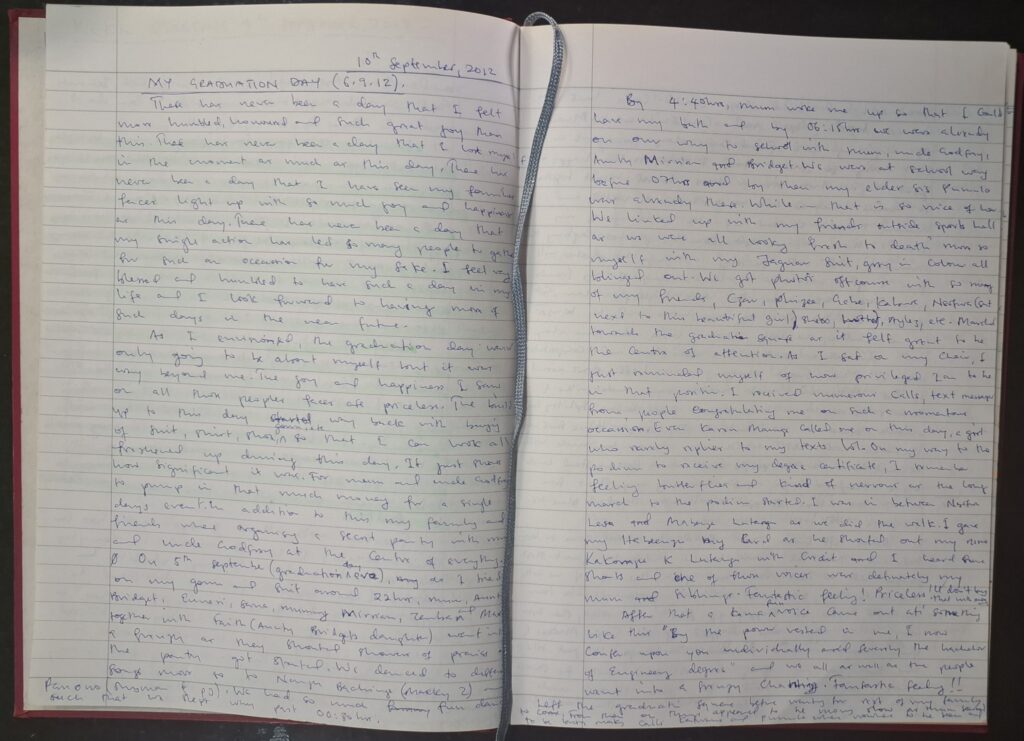
A few days ago, I went back to the journal I kept at the time.
Four days after graduation, on 10th September 2012, I sat down and wrote about the day.
I was twenty three years old.
And reading it now, fourteen years later, I realised something.
I had remembered the photographs.
The journal remembered everything else.
04:40
There is no graduation photograph of my mother waking me up.
At 04:40 in the morning.
The day before, I had been trying on my gown and suit when people at home started making noise and giving me what I described in my journal as “showers of praises.”
Somewhere along the way, a small celebration started.
We danced.
We laughed.
We stayed awake far later than a person graduating the following morning probably should have.
And then, at 04:40, my mother woke me up.
By 06:15, we were already on our way to the University of Zambia.
I had bought a suit for the occasion. A grey Jaguar suit, according to my journal. I was very pleased with it.
At that stage of my life, graduation was not the kind of occasion for doing anything quietly.
I wrote that we were all “looking fresh to death.”
That is exactly how I wrote it.
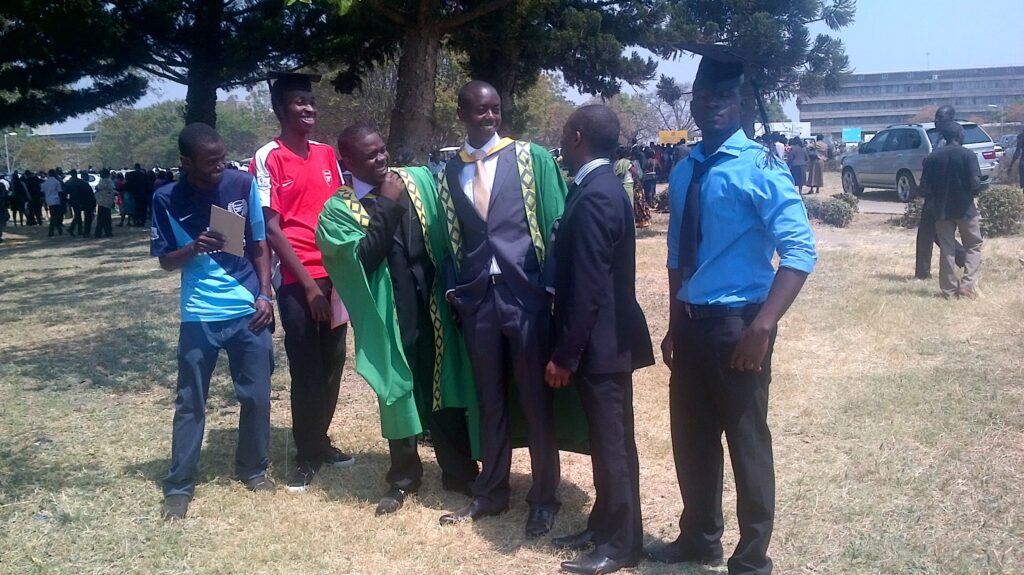
There are photographs of me and my friends outside Sports Hall. Caesar (Czar). Eliphas (Phizee). Gabriel (Ba Gabe). Kabwe. Nsofwa. Luther (Lutz B). Mukolo (Stylez). Others.
We were young engineers about to graduate, dressed in suits and gowns, taking photographs as though somebody had told us this was the last day we would ever look this good.
Perhaps that is what graduation does to you.
It gives you permission to believe, for a few hours, that life has arranged itself around you.
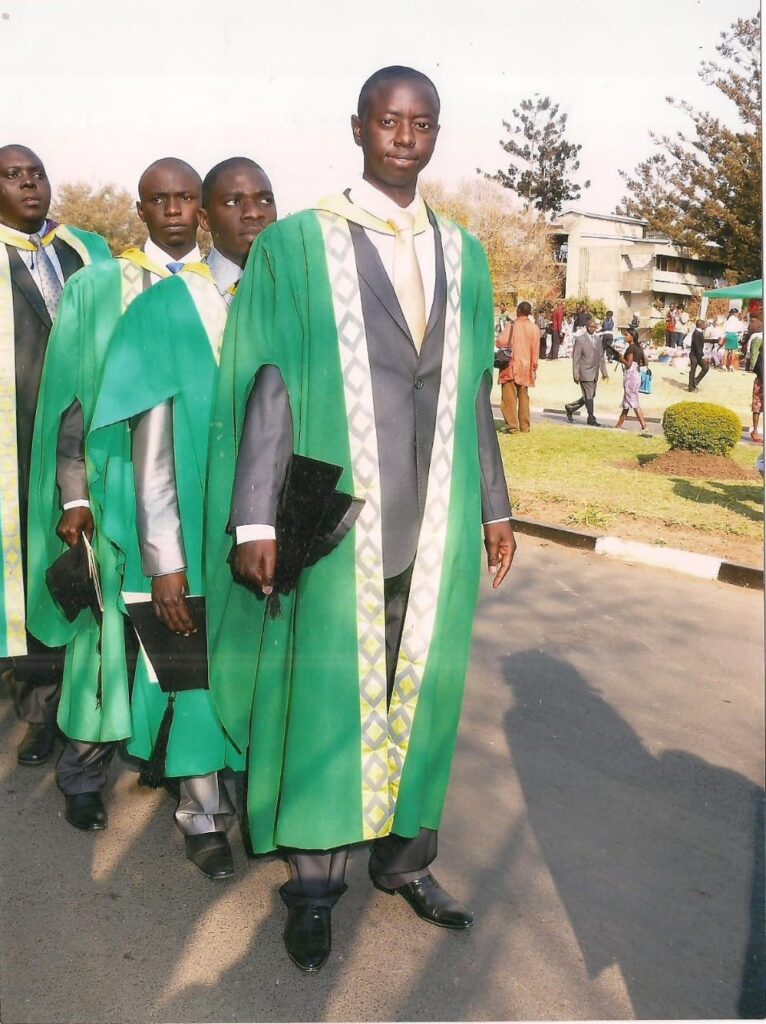
Before the ceremony. Before our names were called. Before any of us knew what the next fourteen years would contain.
The walk
The photograph of me receiving my degree does not show the walk before it.
I remember that walk.
Or rather, I wrote about remembering it.
There were butterflies.
I was nervous.
I was walking between friends as we made our way towards the podium.
Then came my turn.
I handed my card to Dr Habeenzu.
He looked at it and called out:
“Kakompe K. Lutangu, with Credit.”
And then I heard something else.
Shouting.
My family.
My mother and my siblings.
I could hear them clearly.
That is one of those details a photograph cannot preserve.
A photograph can show me approaching the podium.
It can show me greeting Professor Simukanga, the Vice-Chancellor, before receiving my degree.
It can even freeze the handshake itself.
But it cannot show what it felt like to hear people who had travelled through so much of life with you recognise your name before you had even reached the man waiting to hand you the degree.
In my journal, I wrote:
“Fantastic feeling. Priceless. You don’t buy that with money.”
Fourteen years later, I think the younger version of me described it better than I could now.
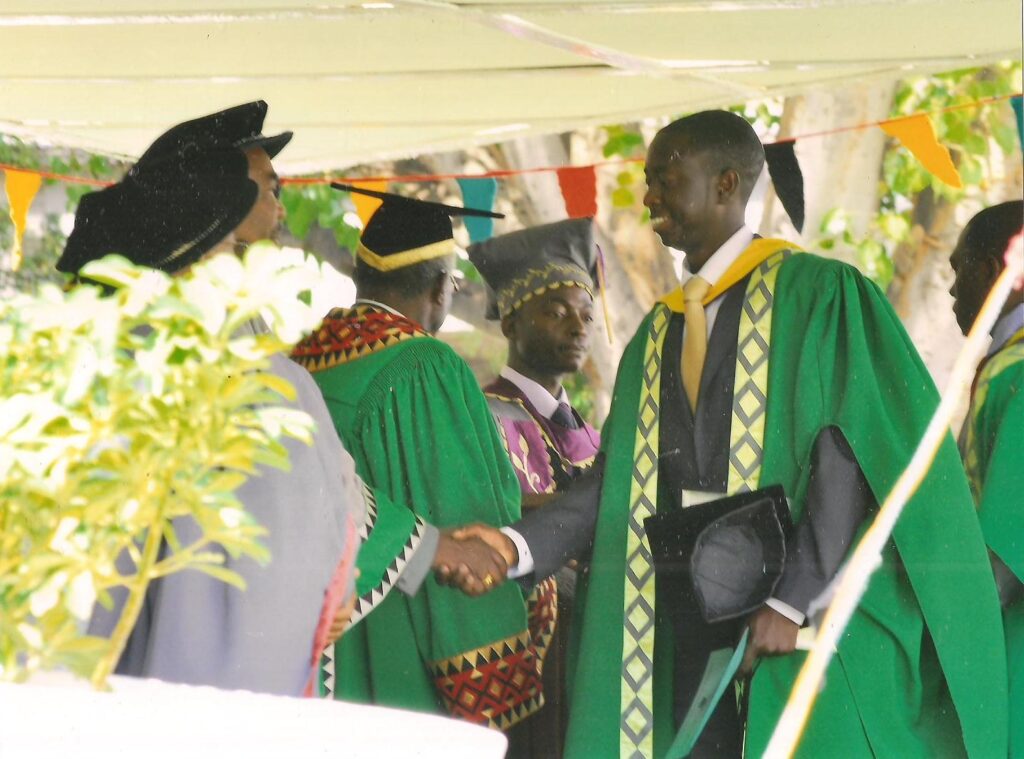
“By the power vested in me…”
I remembered something else when I read the journal.
The moment after the names.
There was a formal declaration.
The kind that generations of graduates have probably heard in one form or another.
Something along the lines of:
“By the power vested in me, I now confer upon you individually and severally the Bachelor of Engineering degree.”
Then we went mad.
The graduates.
The people watching.
Everybody.
It is one of those strange moments in life when formality suddenly gives way to celebration.
There are moments in life when years of ordinary work are compressed into a few seconds.
A name is called.
You walk.
You shake someone’s hand.
A degree is placed in your hands.
And the world has a photograph of the moment.
Years earlier, I would write about what I called our crowning moments those brief points in life when something that has taken years to build finally becomes visible.
Perhaps graduation was one of mine.
Not because the walk across that stage took very long.
But because nothing important enough to be remembered in a photograph had started on that stage.
The photograph of the degree shows the result of that sentence.
It does not show what it felt like to hear it.
The people who were in the photograph
After the ceremony came photographs.
A lot of photographs.
At Goma Lakes.
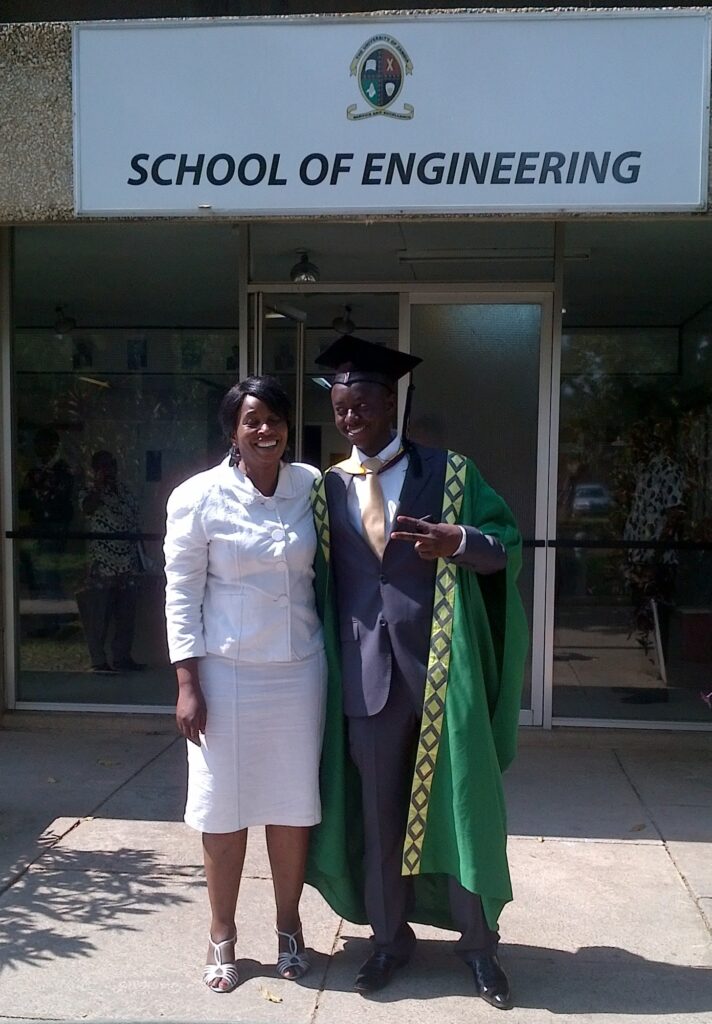
At School of Engineering. Monk Square. School of Mines.
With family.
With university friends.
And with friends from much further back.
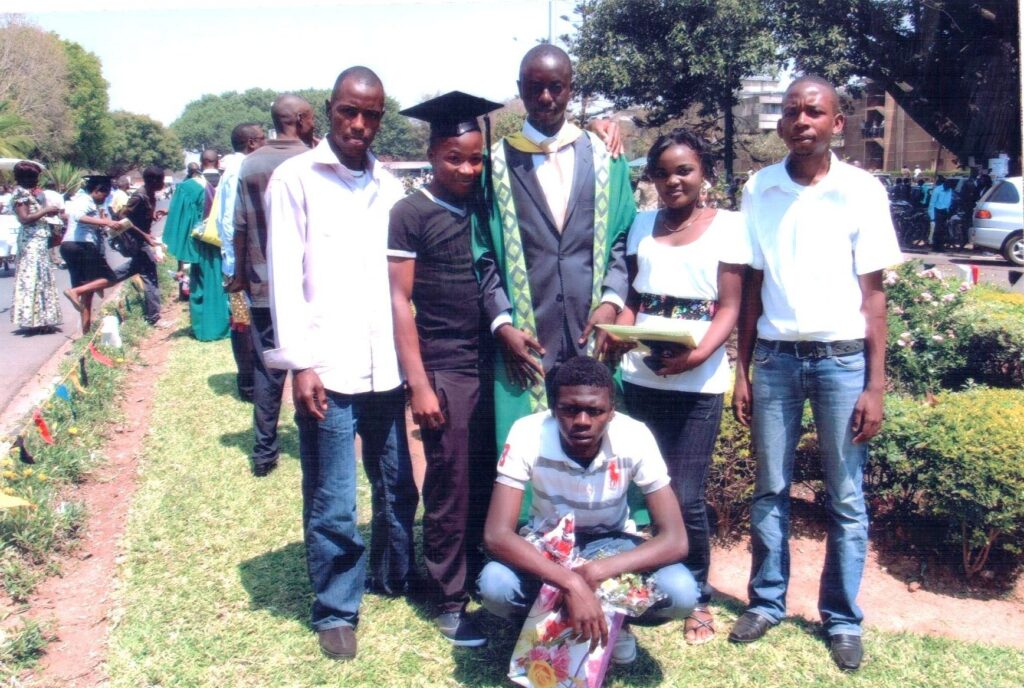
There were my sisters Kafwana and Pumulo. Family members, Sana, Zemba, Mulungwe, Eness, Max. Uncles. Aunties.
And then there were the people from another chapter of my life altogether.
My David Kaunda Class 12-2 friends.
Back then, we had our own name for ourselves.
The Metal People Clan.
The Ayabi.com Clan.
Some of us had gone in different directions after school. Different universities. Different lives. Yet here we were again, standing around Goma Lakes, taking photographs and making noise as though we had never really left that classroom.
There is a photograph of several of us from that class together at Goma Lakes, caught in one of those ordinary light moments that photographs sometimes preserve better than formal ones.
And perhaps that was one of the things that made the day unusual.
My life had stopped being separate chapters.
Family.
School friends.
University friends.
People who had known me in different versions of myself.
For a few hours, they were all in the same place.
The part I did not know about
By the afternoon, I thought the day was ending.
We went home.
I changed.
My mother left the house, saying she had gone to buy drinks.
The house became quieter.
People began disappearing.
Eventually, only a few of us remained.
Nothing about this seemed particularly suspicious to me.
Looking back, I am not sure how I failed to see what was happening.
I was then taken into town under the impression that we had something else to do.
At one point, I was told we needed to pass through a relative’s house.
And then, as we approached, I saw vehicles outside.
That was the first moment I became suspicious.
Then the car moved towards the gate.
Someone started honking.
And people inside started screaming.
The photograph does not show the few seconds before I understood.
It does not show the moment when I saw friends who had spent the whole day with me and had somehow managed to keep the entire thing secret.
Apparently, they had been around me all day carrying information I did not have.
I have to respect that level of commitment.
They had organised a surprise graduation party.
The night I thought was already over
The surprise was only the beginning.
I had already graduated.
Taken the photographs.
Been to Goma Lakes.
Gone home.
Changed clothes.
In my mind, the day had already happened.
Then I arrived at Uncle Robby and Aunty Betty’s place.
And the day started again.
People were shouting before I had properly entered.
The Ayabi.com clan was there.
Including people I had spent the entire day with.
Not one of them had given me a clue.
I still have questions.
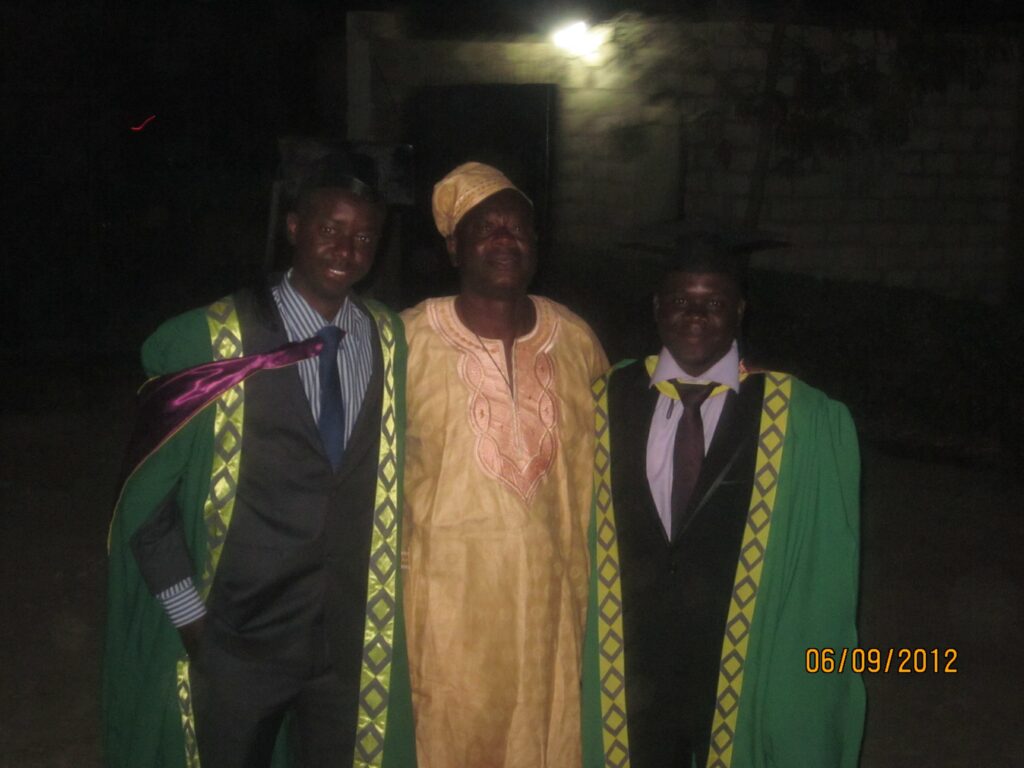
Uncle Robby and Aunty Betty were our hosts that night. Their home had become the place where, somehow, an entire day that I thought was ending had been given another life.
Uncle Robby was dressed in one of those outfits that made it impossible for anybody else in the room to accidentally become the centre of attention.
The kind of Nigerian outfit that looked less like clothing and more like an announcement.
Article about Uncle Robby Matambo and his burial.
Then the night went down.
Food.
Drinks.
The atete-atete clan (my young “uncles”) from Makeni were there.
People coming in.
People dancing.
People telling stories.
And somewhere in the middle of all that, one of my good friends pulled me aside and told me something.
His girlfriend was five months pregnant.
I was only the second person he had told.
I congratulated him.
And then, according to my journal, I told him:
“Na tukula nomba boi.”
I laugh reading that today.
Because perhaps we had.
Or perhaps graduation simply makes everybody briefly believe they have crossed some invisible border into the next version of life.
Either way, the night continued.
Someone opened the dance floor.
Luther and I went down first.
Then the music took over properly.
Nangu Bachinge by Macky 2 came on and something in the room shifted. Not gradually. All at once.
I wrote in my journal that I danced like no one was watching. That I did my Kopala dance and was all over the place. That I lost myself completely. This was true. The song played more than once and I danced with Faith, with my mother, and with Uncle Fube, whose moves nobody in that room had seen before and which I am not sure anyone in that room has seen since.
On the ehe ehe ehe part, the crowd jeered. That particular kind of jeering that only happens when a room has unanimously decided that this is the moment they have all been building toward together. You do not coordinate it. It simply arrives.
Then Kui Chaila by Slap D came on.
My sister Kafwana had been waiting for exactly this.
She started the call.
“Kuchita shani!”
The room answered back.
“Kui Chaila!”
“Kuchita shani!”
“Kui Chaila!”
Kafwana leading. The room responding. Back and forth, louder each time, until nobody was standing still. That particular call and response between a sister and a room full of people who had all come for the same reason.
By then, no one was pretending they were going home early.
Then Chop My Money by P-Square, Akon and May D came on and we showed the elders in the room exactly how that generation believed dancing should be done. Hands in the air. Money thrown into imaginary skies. The kind of choreography that requires no rehearsal because everyone in the room already knows every move.
Muchi and Kiboh had, by this point, committed fully to the evening.
Uncle Fube’s contribution to the night can only be described as legendary. He produced moves that evening which I had never seen from him and have not seen since. There is no photographic evidence of what he did on that dance floor. There does not need to be. The people who were in that room remember.
And somehow the night kept extending itself.
By 02:00, it was already Friday morning.
The party was still going.
Some people had left because they needed to go to work.
Others were still very much present.
I was still standing.
Which, according to the journal, was important enough for me to record.
What I said when they gave me the “microphone”
By then it was late on Thursday night.
The day had crossed into the kind of celebration where time had stopped being particularly important.
I had graduated.
Been photographed.
Been surprised.
Danced.
Watched people who had known me in different seasons of life gather in one place.
And then the late Uncle Mapulanga gave me the microphone.
There was one thing on my mind.
My family.
I thanked everyone who was present and had helped make the day possible.
And I mentioned my late Uncle Misheck.
Long before the graduation gown, long before engineering and the University of Zambia, he had helped make university feel like something I could imagine for myself. I had looked up to him. He had been part of the beginning of that dream.
I did not know, standing there with late on a Thursday night, how many people had contributed something to the person receiving that degree.
The note I wrote four days later
Four days after graduation, when the music had stopped and everyone had gone back to ordinary life, I opened my journal and wrote down one regret.
I had not acknowledged my mother’s contribution enough.
Reading that sentence fourteen years later, I understand why it was on my mind.
Not because she had only helped me prepare for graduation.
And not because her contribution started when I received the degree.
It had been there long before that day.
She was the one who noticed that the school system was not bringing me up to speed and sat with me until I learned to read.
She was there for as far as I can remember for all the report card collection days at school.
Every one she could make, despite everything else competing for her time.
She had conversations with me that changed the direction of my thinking.
She was also responsible, without knowing it at the time, for another part of my life that would later become important to me.
She had bought a book for something else. I thought it was too beautiful to be used for its intended purpose and decided to keep it.
I started writing in it.
Years later, I am still writing.
So perhaps it makes sense that, four days after graduating, the younger version of me was sitting with his journal and thinking about his mother.
The two stories had been connected long before I knew they were.
And on graduation day itself, she was still doing what she had been doing for years.
Showing up.
What fourteen years does to a photograph
Fourteen years have passed since that Thursday.
The young man in the photographs did not know what was coming.
He did not know the jobs.
The mistakes.
The decisions that would work.
The ones that would not.
The people he would meet.
The people he would lose.
The places life would take him.
The company he would help build.
The family he would have.
He did not know which friendships would remain.
He did not know what he would one day write about.
He only knew that on 6 September 2012, something very important had happened.
And for that day, that was enough.
That is one of the things I like about journals.
Photographs tell you what you looked like.
Journals sometimes tell you who you were.
The photograph shows me receiving a degree.
The journal captures how it felt:
“Fantastic feeling. Priceless. You don’t buy that with money.”
Getting woken up before sunrise.
Feeling nervous before my name was called.
Hearing my family shout.
Taking photographs on a horse.
Being tricked into attending my own party.
Dancing until three in the morning.
Standing up to speak when I probably should have been sitting down quietly somewhere.
And then, four days later, sitting alone with a journal and realising there was one person I should have thanked more loudly.
The photograph doesn’t tell the whole story.
It captures the person standing in the frame.
The degree.
The handshake.
The smile.
What it cannot capture are all the hands that helped make it possible to stand there in the first place.
Someone who woke up early.
Someone who helped before the event.
Someone who contributed something to the journey but was no longer there to see where it led.
Friends and family who may have spent only a season in your life but still left something behind that you carried into the next one.
A teacher.
A relative.
A friend.
A conversation you almost forgot.
An encounter that seemed ordinary at the time but quietly changed the direction of something that came after it.
We rarely know, while we are living our lives, who is helping shape us.
Perhaps that is what fourteen years has done to these photographs.
It has not changed what is in them.
I am still standing there.
Still shaking the Vice-Chancellor’s hand.
Still surrounded by friends.
Still wearing the suit that seemed important enough to prepare for.
But fourteen years later, I can see more.
Not because the photograph has changed.
Because I have.
I can now see some of the people whose contributions were already behind me.
I can recognise the journeys that had brought us together.
I can remember those who were present that day and those who had helped me get there but were not.
And perhaps that is what happens when enough time passes.
You stop looking only at the person in the photograph.
You start wondering about everything outside the frame.
And sometimes, if you were fortunate enough to write it down, you can go back to the journal and meet the person who still remembered.